![[H]ard|Forum](/styles/hardforum/xenforo/logo_dark.png)
Navigation
Install the app
How to install the app on iOS
Follow along with the video below to see how to install our site as a web app on your home screen.
Note: This feature may not be available in some browsers.
More options
-
Some users have recently had their accounts hijacked. It seems that the now defunct EVGA forums might have compromised your password there and seems many are using the same PW here. We would suggest you UPDATE YOUR PASSWORD and TURN ON 2FA for your account here to further secure it. None of the compromised accounts had 2FA turned on.
Once you have enabled 2FA, your account will be updated soon to show a badge, letting other members know that you use 2FA to protect your account. This should be beneficial for everyone that uses FSFT.
You are using an out of date browser. It may not display this or other websites correctly.
You should upgrade or use an alternative browser.
You should upgrade or use an alternative browser.
AI's Water and Electricity Use Soars In 2026
- Thread starter erek
- Start date

- Joined
- Dec 19, 2005
- Messages
- 17,421
“Nearly 50,000 Lake Tahoe residents have to find a new power source after their energy source looks to redirect lines to data centers”
https://fortune.com/2026/05/12/lake-tahoe-data-center-49000-residents-power-source/It's bonkers that this passed when the data centers will use more power than the entire state of Utah currently consumes. Not only that, but the state has a drought. What idiot thought this was a good idea? Does seem like democracy isn't working as intended. We're seeing this with a lot of states.
It is working as intended. The people are just dumb as rocks and keep voting these people into office. As long as they have the right letter next to their name on the ballot and hate the right groups they don't pay much attention to what they do in between elections. Some people do, sure, but it is a very small percentage of the population.

DukenukemX
[H]F Junkie
- Joined
- Jan 30, 2005
- Messages
- 11,192
https://smry.ai/fortune.com/2026/05/12/lake-tahoe-data-center-49000-residents-power-source“Nearly 50,000 Lake Tahoe residents have to find a new power source after their energy source looks to redirect lines to data centers”
https://fortune.com/2026/05/12/lake-tahoe-data-center-49000-residents-power-source/
Got the same problem with Josh Gottheimer, the prick. He's trying to pass age verification laws and a bill specifically made for Hasan Piker. He's in my district and I have a chance to vote him out. Because he's a Democrat, his chances of losing is nearly zero. I'm still going to vote against him, but he's unlikely to lose.It is working as intended. The people are just dumb as rocks and keep voting these people into office. As long as they have the right letter next to their name on the ballot and hate the right groups they don't pay much attention to what they do in between elections. Some people do, sure, but it is a very small percentage of the population.
Not idiots; greedy little shit with no ethics and only a care for bloated income. They will take the money and go elsewhere far away from data centers.It's bonkers that this passed when the data centers will use more power than the entire state of Utah currently consumes. Not only that, but the state has a drought. What idiot thought this was a good idea? Does seem like democracy isn't working as intended. We're seeing this with a lot of states.

- Joined
- Jul 25, 2012
- Messages
- 2,463
It's not a R or D issue, let's not forget the AI lovefest currently underway in Beijing and who is the biggest cheerleader of these things.https://smry.ai/fortune.com/2026/05/12/lake-tahoe-data-center-49000-residents-power-source
Got the same problem with Josh Gottheimer, the prick. He's trying to pass age verification laws and a bill specifically made for Hasan Piker. He's in my district and I have a chance to vote him out. Because he's a Democrat, his chances of losing is nearly zero. I'm still going to vote against him, but he's unlikely to lose.
- Joined
- Dec 19, 2005
- Messages
- 17,421
https://www.ft.com/content/3788778f-ea93-4811-80a8-4c8f4c5c0b1f?syn-25a6b1a6=1
“Ford shares surge after launch of power unit for data centres New subsidiary pivots to energy storage batteries for AI after disastrous electric vehicle writedown Production at Ford’s Blue Oval battery park, under construction in Marshall, Michigan, is expected to begin this year Shares in Detroit carmaker Ford surged more than a fifth over two days, the sharpest jump since 2020, on investor hopes that its new energy unit will profit from the US data centre boom.”
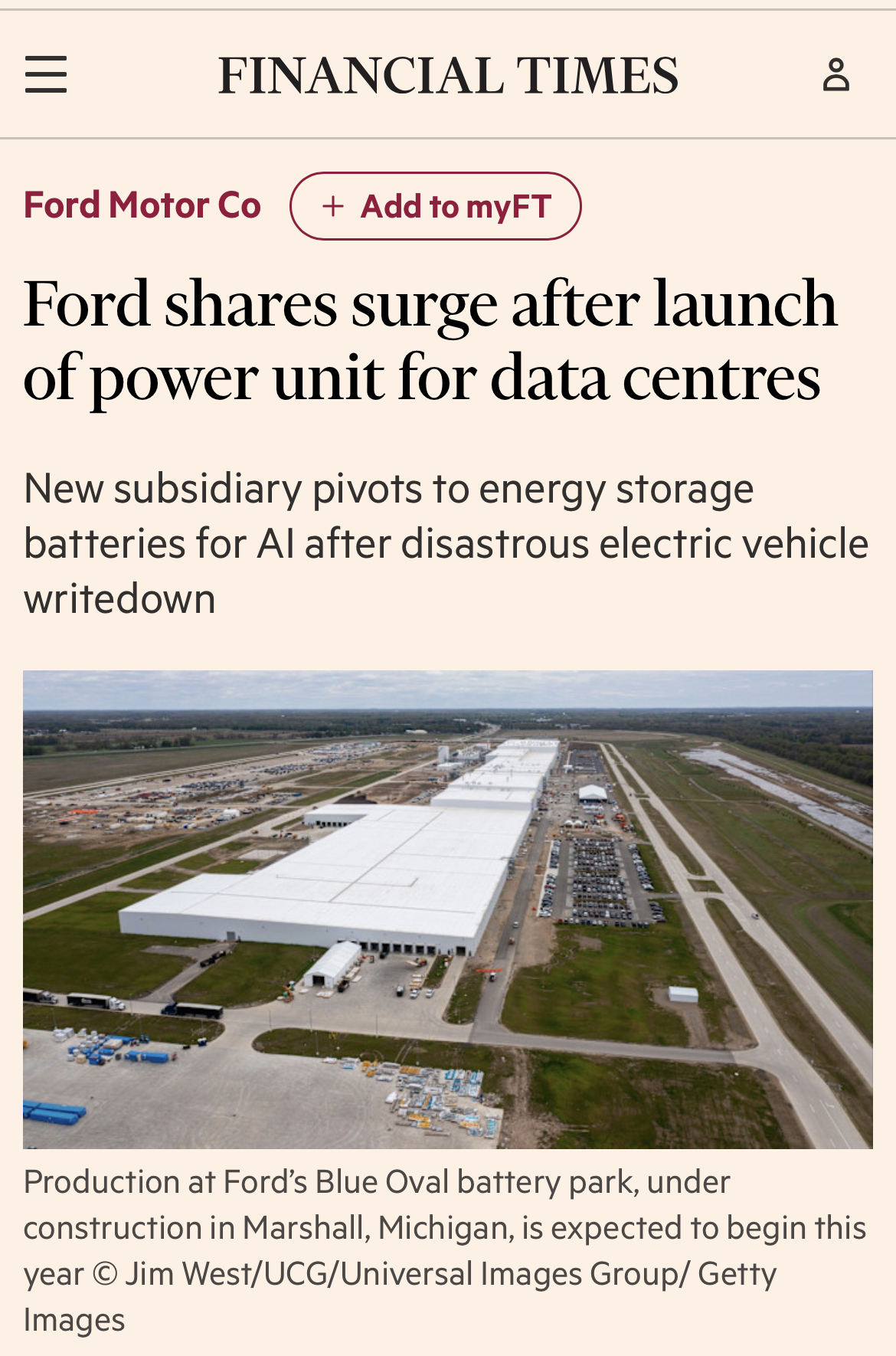
“Ford shares surge after launch of power unit for data centres New subsidiary pivots to energy storage batteries for AI after disastrous electric vehicle writedown Production at Ford’s Blue Oval battery park, under construction in Marshall, Michigan, is expected to begin this year Shares in Detroit carmaker Ford surged more than a fifth over two days, the sharpest jump since 2020, on investor hopes that its new energy unit will profit from the US data centre boom.”
- Joined
- Dec 19, 2005
- Messages
- 17,421
“Americans Would Rather Have a Nuclear Plant In Their Backyard Than a DatacenterBeauHD 2 hours ago | 18 |
| A new Gallup survey found that 71% of Americans oppose having an AI data center built near them, making the facilities even less popular than nearby nuclear plants, which 53% oppose. The Register reports: When it comes to the reasons for opposing AI campuses, half of all respondents cite the effect on resources, with excess water usage and potential power grid constraints topping the list. Concern about loss of farmland and nature was surprisingly low, with just 7 percent mentioning this, but it is possible the scores are higher in rural areas. Quality-of-life concerns such as increased traffic were put forward by nearly a quarter, while a fifth mentioned higher utility bills. Many were worried about AI specifically: that it would replace human workers, that they don't trust it, that it is moving too fast, and that the industry needs regulating. Perhaps the latter sentiment is why President Trump appears to have shifted his own position on the need for AI regulations. Conversely, those in favor of datacenters cite economic benefits, with 55 percent mentioning increased job opportunities, and 13 percent saying it is because of increased tax revenues. [...] This being America in 2026, Gallup looked at how attitudes stack up depending on political affiliation. It found that Democrats, at 56 percent, are much more likely than Republicans to be strongly opposed to a server farm in their vicinity. But 39 percent of Republicans are also strongly opposed, while another 24 percent are somewhat averse to it, and only about a third are in favor. Gallup points out the contradiction: for AI usage to expand in the US, facilities that can handle the necessary computing power will have to be built. But most Americans appear to take a "not in my backyard" attitude to new bit barns, and that attitude has grown in strength.” |
https://newsletter.semianalysis.com/p/from-tokens-to-burgers-a-water-footprint
probably already posted here, but colossus-2 the biggest AI datacenter in the world running.. consumer has much water as 2.5 in Nout fastfood location when you consider beef water usage.
The duel is on. Colossus 2’s blue water footprint is around 346 million gallons per year, while an average In-N-Out store (yes, burgers only) comes in at around 147 million gallons. That’s roughly a ~2.5 : 1 ratio.
2700 millions of tokens generated per burger in water usage terms, an user would need to use grok for 668 years, 30 times a day to have the water usage of eating an average burger.
evaporating cooling system where they still exist do use a lot water sure, but for modern closed loop this is a total made up issue (if golf course or beef eating were new things and the stuff people talked about, AI compute would go quite under the radar as quite small relative to those).
Many billionaires are financing an anti-AI campaign spreading a lot of non-sense in it.
probably already posted here, but colossus-2 the biggest AI datacenter in the world running.. consumer has much water as 2.5 in Nout fastfood location when you consider beef water usage.
The duel is on. Colossus 2’s blue water footprint is around 346 million gallons per year, while an average In-N-Out store (yes, burgers only) comes in at around 147 million gallons. That’s roughly a ~2.5 : 1 ratio.
2700 millions of tokens generated per burger in water usage terms, an user would need to use grok for 668 years, 30 times a day to have the water usage of eating an average burger.
evaporating cooling system where they still exist do use a lot water sure, but for modern closed loop this is a total made up issue (if golf course or beef eating were new things and the stuff people talked about, AI compute would go quite under the radar as quite small relative to those).
Many billionaires are financing an anti-AI campaign spreading a lot of non-sense in it.
Last edited:
Many billionaires are financing an anti-AI campaign spreading a lot of non-sense in it.
Foreign adversaries too
- Joined
- May 20, 2025
- Messages
- 466
so the takeaway is - outlawing data centers AND red meat consumption would be the best long term solution?.
Many billionaires are financing an anti-AI campaign spreading a lot of non-sense in it.
And at least the food from In n out provides a useful public benefit. Grok only produces complete AI slop for sycophants and asswipes
https://newsletter.semianalysis.com/p/from-tokens-to-burgers-a-water-footprint
2700 millions of tokens generated per burger in water usage terms, an user would need to use grok for 668 years, 30 times a day to have the water usage of eating an average burger.
People have to eat food. They don't need to use tokens.
Food source water usage differ greatly, high water usage food tend to be pure luxury (nice one, but pure luxury, there is no need for it)People have to eat food. They don't need to use tokens.
Using no special amount of water doing it too, opposition for AI should at least be "fair". The argument that self-driving is producing as much value than eating beef instead of chicken/turkey/pork could be easy to make, let alone the upcoming robots control for optimus model Colossus-2 are training or the space-X compute going on with those supercomputers.Grok only produces complete AI slop for sycophants and asswipes
Last edited:
- Joined
- Jan 14, 2007
- Messages
- 17,020
But how many football fields long is it? Just asking as an Americanhttps://newsletter.semianalysis.com/p/from-tokens-to-burgers-a-water-footprint
probably already posted here, but colossus-2 the biggest AI datacenter in the world running.. consumer has much water as 2.5 in Nout fastfood location when you consider beef water usage.
The duel is on. Colossus 2’s blue water footprint is around 346 million gallons per year, while an average In-N-Out store (yes, burgers only) comes in at around 147 million gallons. That’s roughly a ~2.5 : 1 ratio.
2700 millions of tokens generated per burger in water usage terms, an user would need to use grok for 668 years, 30 times a day to have the water usage of eating an average burger.
evaporating cooling system where they still exist do use a lot water sure, but for modern closed loop this is a total made up issue (if golf course or beef eating were new things and the stuff people talked about, AI compute would go quite under the radar as quite small relative to those).
Many billionaires are financing an anti-AI campaign spreading a lot of non-sense in it.
30 gallon of football field longBut how many football fields long is it? Just asking as an American
- Joined
- Dec 19, 2005
- Messages
- 17,421
“Nvidia's solution to the AI energy problem is mini data centers next to local power substations and, of course, selling even more GPUs
By Jeremy Laird published yesterdayAI hardware coming to your neighborhood...
That something as superficially straight forward as plain old energy supply is turning out to be a major limiting factor in the AI revolution is one of those delightful unexpected quirks that keeps us all on our toes. Who'd have thought in just a few short years the world would be spooling up more GPUs than the power grid can cope with?”
https://www.pcgamer.com/hardware/gr...tations-and-of-course-selling-even-more-gpus/

Comixbooks
Fully [H]
- Joined
- Jun 7, 2008
- Messages
- 25,881
Wait until they get to hear all that noise. Data Centers aren't exactly quite.
View: https://youtu.be/9ByT2TU02DM?si=ZjfKjgq_ltJXLyO6
Ghey Ai the Government should just regulate this stuff. Its like putting a Wind Turbine on a Farm Field. Our City and a nearby city passed a Year and a half settlement to understand more about data centers basically telling them its unwanted in our city.
- Joined
- Dec 19, 2005
- Messages
- 17,421
“Some Datacenters Divert Power from Homes. Will It Drive Homeowners to Solar and Batteries?EditorDavid an hour ago | 10 |
| An anonymous reader shared this report from Electrek: A Nevada utility just told 49,000 Lake Tahoe residents that it's redirecting 75% of their electricity supply to data centers, and they have less than a year to find a new power source. It's one of the starkest examples yet of the AI boom's impact on everyday Americans... NV Energy needs the capacity for data centers being built by Google, Apple, and Microsoft around the Tahoe-Reno Industrial Center east of Reno, according to Fortune... Data centers drove half of all US electricity demand growth last year.... That dynamic — small residential customers losing out to massive industrial electricity buyers — is exactly what's driving the broader shift to distributed solar and storage. When the grid becomes unreliable or unaffordable because of data center demand, the homeowners who have solar panels and a battery in the garage are the ones with options. "The shift is measurable," they argue: Third-party ownership models (leases and power purchase agreements), which still qualify for the [U.S.] commercial investment tax credit through 2027, are projected to grow 25% in 2026 and capture up to 69% of residential installations, up from roughly 45% in 2025. Homeowners aren't waiting for incentives to come back — they're finding new ways to get solar on their roofs... [A] battery that can store cheap solar energy and deploy it during peak hours is increasingly essential. California utility customers alone are adding roughly 8,000 new home batteries per month — about 100 MW of new storage capacity. Municipal programs are accelerating the trend. Ann Arbor, Michigan, recently became the first US city to directly deploy solar and battery systems on 150 homes through its city-owned utility. Vermont's Green Mountain Power is offering home batteries at little to no upfront cost. These programs signal that utilities themselves recognize the value of distributed “ |
- Joined
- Dec 19, 2005
- Messages
- 17,421
“America's power grid can't keep up with AI demand
Grid engineers, utility executives, and regulators describe a system where permitting, supply chains, and queues can't match the speed of data center growth
The U.S. needs about 5,000 miles of high-voltage transmission per year to keep pace with electricity demand. In 2024, just 888 miles were completed, according to an analysis by Grid Strategies. That gap is widening even as data center developers race to bring tens of gigawatts of new load online. The result is a structural mismatch between the speed at which demand arrives and the speed at which the grid can absorb it.”
https://www.newsweek.com/how-data-centers-are-set-to-impact-the-value-of-your-home-11939599
- Joined
- Dec 19, 2005
- Messages
- 17,421
“America's power grid can't keep up with AI demand
Grid engineers, utility executives, and regulators describe a system where permitting, supply chains, and queues can't match the speed of data center growth
The U.S. needs about 5,000 miles of high-voltage transmission per year to keep pace with electricity demand. In 2024, just 888 miles were completed, according to an analysis by Grid Strategies. That gap is widening even as data center developers race to bring tens of gigawatts of new load online. The result is a structural mismatch between the speed at which demand arrives and the speed at which the grid can absorb it.”
https://www.newsweek.com/how-data-centers-are-set-to-impact-the-value-of-your-home-11939599
“Datacenters slurping up so much juice they boosted prices 75% in largest US energy market
BYO power for AI bit barns may be the best way to ease the problem, says energy watchdogPrices in the United States' largest wholesale power market have nearly doubled in the past year thanks to demand from datacenters. And an independent watchdog predicts things will only get worse without some serious changes.
The PJM Interconnection serves all or parts of 13 states and the District of Columbia in the eastern US, including Northern Virginia, that’s got the densest cluster of datacenters in the world. The surge in wholesale power costs across PJM was outlined on Thursday by Monitoring Analytics, a firm that serves as the official market monitor for the Interconnection, in its Q1 2026 state of the market report.”
https://www.theregister.com/on-prem...elp-drive-75-jump-in-pjm-power-prices/5241491
DukenukemX
[H]F Junkie
- Joined
- Jan 30, 2005
- Messages
- 11,192
If the government was to regulate it, then I would require data centers to be powered entirely by renewable energy. Not only that but put someplace in the middle of nowhere. I'd personally want data centers audited because there's a good chance they aren't just using them to train AI, but to comb through a lot of personal data that these data centers were clearly not authorized to have. Good luck with our current politicians.Ghey Ai the Government should just regulate this stuff. Its like putting a Wind Turbine on a Farm Field. Our City and a nearby city passed a Year and a half settlement to understand more about data centers basically telling them its unwanted in our city.
If the government was to regulate it, then I would require data centers to be powered entirely by renewable energy. Not only that but put someplace in the middle of nowhere. I'd personally want data centers audited because there's a good chance they aren't just using them to train AI, but to comb through a lot of personal data that these data centers were clearly not authorized to have. Good luck with our current politicians.
The current US government would simply allow a bribery bypass like they do with every regulation, and they certainly wouldn't push renewables. If anything they'd demand oil or coal be used.
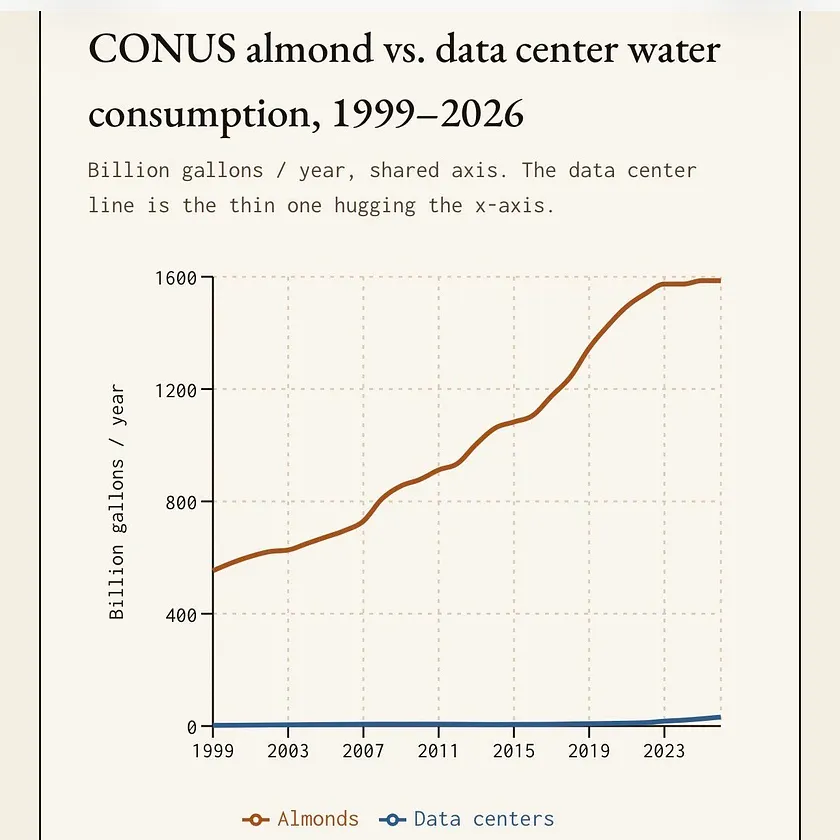
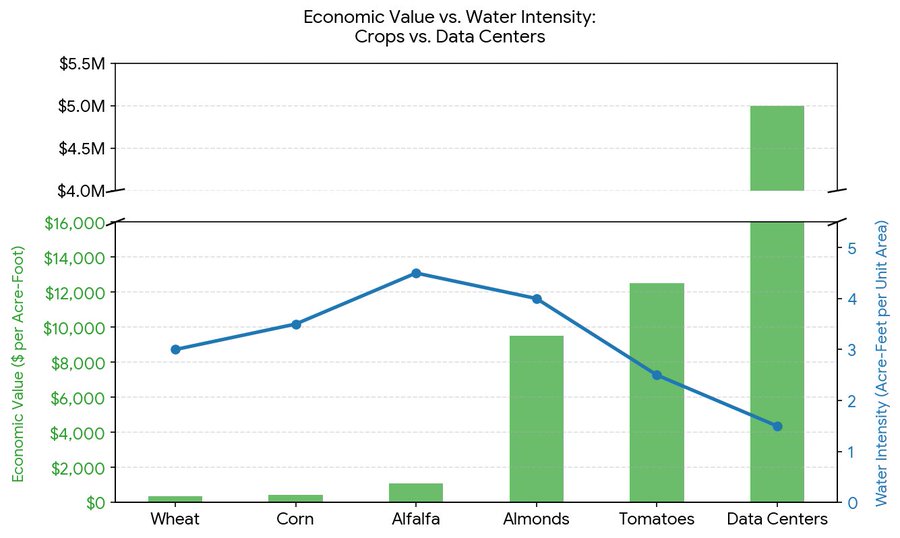
Almonds are quite water intensive, high protein content and dense and grown in very dry region in the US, trees for which you cannot take an year skip break if it get too dry, but they made a lot of progress (still good return per liter)My god. I knew it was bad but i had no idea it was this bad..

- Joined
- Feb 23, 2004
- Messages
- 13,144
Man, if only we had invested in power and water infrastructure in the past. If only someone could have known there could be increased power and water demands, for public and industrial use, then maybe something could have been done? Like build some nuclear plants? How about even a single natural gas power plant to utilize the near infinite, cheap natural gas the US is capable of producing? If only there were signs.
But I can eat almonds. Don't think data centers contribute anything useable by lifeforms on the planet.Almonds are quite water intensive, high protein content and dense and grown in very dry region in the US, trees for which you cannot take an year skip break if it get too dry, but they made a lot of progress (still good return per liter)
But I can eat almonds. Don't think data centers contribute anything useable by lifeforms on the planet.
Every single company including your almond farms/food sources to the logistics to get them to you etc uses + runs on compute.
We are a technological dependent species/society/civilization - like it or not.

- Joined
- Jul 27, 2004
- Messages
- 2,776
Every single company including your almond farms/food sources to the logistics to get them to you etc uses + runs on compute.
Yep, there's not enough compute for food logistics. We need more data centers to clear that bottleneck.
Yep, there's not enough compute for food logistics. We need more data centers to clear that bottleneck.
We wouldn't get to where we are now, without having built what we did then
So yes, more will always be needed

Prince Valiant
Gawd
- Joined
- May 3, 2023
- Messages
- 772
How did man ever survive without the shining star of the data center?
How did man ever survive without the shining star of the data center?
Well if you want to return to that you'll just have to kill billions via starvation etc first
Even by exaggeration standard, that can be a strange conversation to talk about it on the Internet, that Netflix, the world stocks markets, banking, youtube, world of warcraft, office 365, amazon, salesforce, zoom is not something being used or that Claude is not something people use....But I can eat almonds. Don't think data centers contribute anything useable by lifeforms on the planet.
A lot of world goes through them.
Almonds did not exist in North America until quite recently has well (or golf course), like about every energy intensive element in our modern world, the focus on one versus the others is in part a choice.How did man ever survive without the shining star of the data center?
Golf course water usage will be still in 2026, what 15-20 time those of all datacenters combined direct water usage, 3/4 time including the power generation, talking about one versus the other in a special way, would it be the case without rich activist pushing it (because they are in reality against AI for the tech itself, not its water use, it is just something that they did find test really well among the public).
Is playing golf more "use" than self-driving or google map ? Going by what people are willing to pay for and trying to stay judgemental free is not a bad way to go about those things.
Last edited:
Even by exaggeration standard, that can be a strange conversation to talk about it on the Internet, that Netflix, the world stocks markets, banking, youtube, world of warcraft, office 365, amazon, salesforce, zoom is not something being used or that Claude is not something people use....
A lot of world goes through them.
Almonds did not exist in North America until quite recently has well (or golf course), like about every energy intensive element in our modern world, the focus on one versus the others is in part a choice.
Golf course water usage will be still in 2026, what 15-20 time those of all datacenters combined direct water usage, 3/4 time including the power generation, talking about one versus the other in a special way, would it be the case without rich activist pushing it (because they are in reality against AI for the tech itself, not its water use, it is just something that they did find test really well among the public).
Is playing golf more "use" than self-driving or google map ? Going by what people are willing to pay for and trying to stay judgemental free is not a bad way to go about those things.
I don't eat almonds except rarely and I don't golf. Does that mean I can still bitch about AI data center water useage? Or am I banned from bringing it up because some other industries are worse? Is that the metric now? If you're not worst then nobody can complain about it?

- Joined
- Jan 26, 2007
- Messages
- 1,453
I was given a Brain to use, not a Brain to waste.

- Joined
- Aug 26, 2023
- Messages
- 632
How do we know AI is to blame? Maybe you guys are just taking longer showers and leaving lights on while you’re gone? So presumptuous.
They make it hotter so things that like it hotter will find it usefulBut I can eat almonds. Don't think data centers contribute anything useable by lifeforms on the planet.

- Joined
- Dec 19, 2005
- Messages
- 17,421
“Data centers could hike power costs in some states over 50% by 2030
But the power grid as it once was might be no match for the technological demands of the 2020s. Retail electricity prices have soared in recent years, an increase fast outpacing inflation over the same period, in part due to the rising power costsassociated with the artificial intelligence-driven infrastructure boom. Electricity costs have been one of the factors fueling the recent nosedive AI has taken in public polling, and a new study suggests residential utility pain tied to the technology needs of this decade might be just getting started.Between 2018 and 2023, the share represented by data centers in total U.S. electricity use rose from 1.9% to 4.4%, according to a study published last week in the journal Environmental Research Letters.”
https://fortune.com/2026/05/19/data-centers-electricity-costs-us-public-opinion/
- Joined
- Dec 19, 2005
- Messages
- 17,421
"Copper cold plates could slash data-center energy usage
Ultra-high-performance cold plate development through topology optimization and electrochemical additive manufacturing
The rapid growth of AI is increasing heat loads and needs for high-performance thermal management. Liquid-cooled cold plates often face a thermal-hydraulic trade-off. Although topology optimization helps to alleviate this trade-off, it typically generates optimal fin architectures that are difficult to fabricate, with sub-100 μm feature scales. Here, we report a cold plate design workflow that couples topology optimization with electrochemical additive manufacturing to directly print high-resolution pure-copper coolers. Experiments show that the topology-optimized cold plate achieves up to 32% lower thermal resistance at a fixed flow rate and up to 68% lower pressure drop at equal thermal resistance compared with pin fin designs. A data center energy analysis indicates that, under the stated assumptions, the proposed solution requires only 1.1% of total data center energy use for cooling. By bridging the gap between computational design freedom and manufacturing capability, this approach provides a pathway for liquid cooling of future electronics."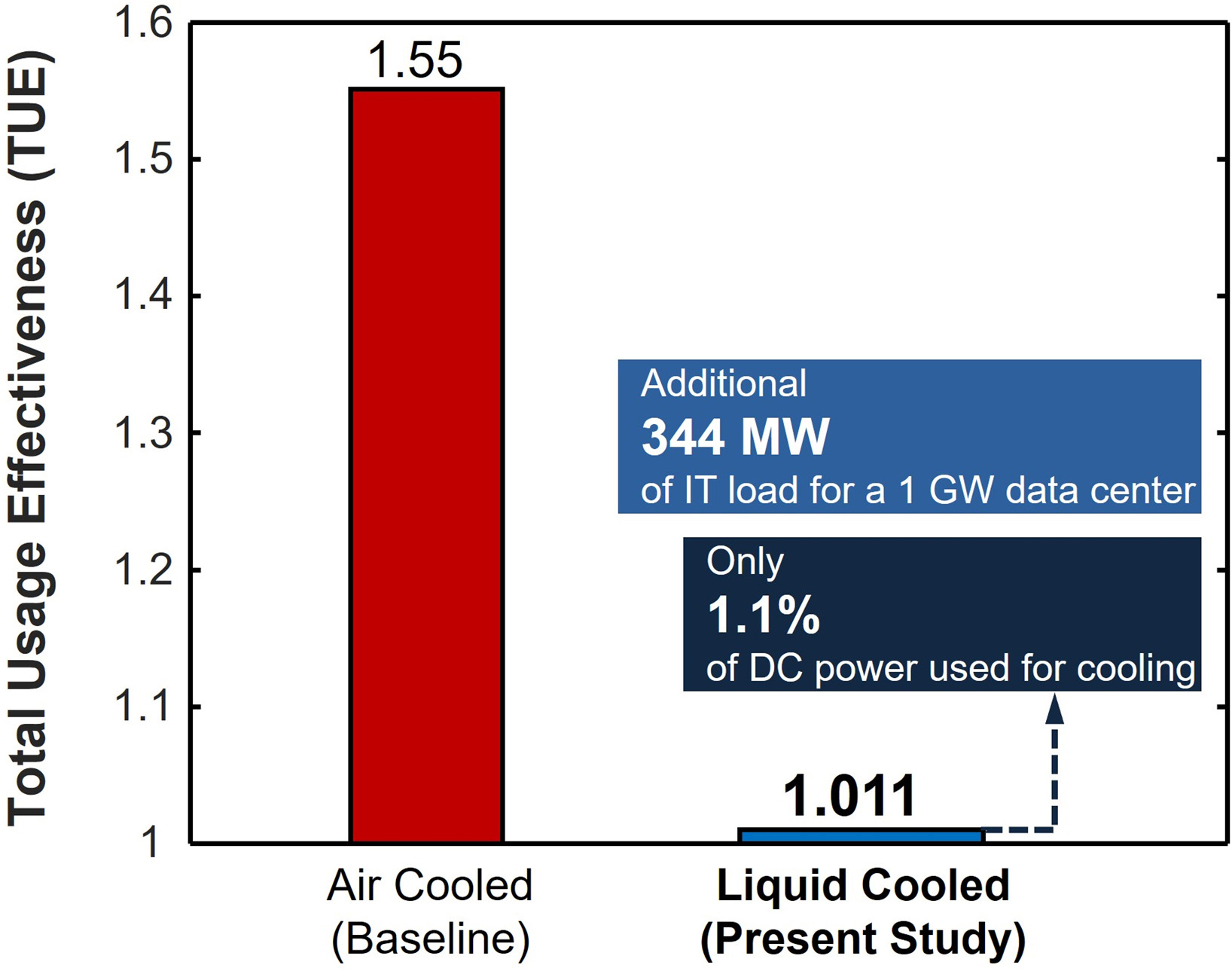
"Shown is a comparison of system total usage effectiveness (TUE) between the baseline air cooling solution (red bar) and the liquid cooling solution proposed here (blue bar). Analysis was done for a target chip temperature of 85°C at an ambient temperature of 25°C in a 42U rack server dissipating a total of 167 kW."
Source: https://www.eurekalert.org/news-releases/1126418
If it cost them more money to go this route they rather make life miserable for everyone else and save a few bucks."Copper cold plates could slash data-center energy usage
Ultra-high-performance cold plate development through topology optimization and electrochemical additive manufacturing
The rapid growth of AI is increasing heat loads and needs for high-performance thermal management. Liquid-cooled cold plates often face a thermal-hydraulic trade-off. Although topology optimization helps to alleviate this trade-off, it typically generates optimal fin architectures that are difficult to fabricate, with sub-100 μm feature scales. Here, we report a cold plate design workflow that couples topology optimization with electrochemical additive manufacturing to directly print high-resolution pure-copper coolers. Experiments show that the topology-optimized cold plate achieves up to 32% lower thermal resistance at a fixed flow rate and up to 68% lower pressure drop at equal thermal resistance compared with pin fin designs. A data center energy analysis indicates that, under the stated assumptions, the proposed solution requires only 1.1% of total data center energy use for cooling. By bridging the gap between computational design freedom and manufacturing capability, this approach provides a pathway for liquid cooling of future electronics."
View attachment 804983
"Shown is a comparison of system total usage effectiveness (TUE) between the baseline air cooling solution (red bar) and the liquid cooling solution proposed here (blue bar). Analysis was done for a target chip temperature of 85°C at an ambient temperature of 25°C in a 42U rack server dissipating a total of 167 kW."
Source: https://www.eurekalert.org/news-releases/1126418